Niagara Escarpment Crossing Environmental Assessment

Plan for a north-south transportation crossing of the Niagara Escarpment.

A location indicator for a map

Location

Grimsby, Lincoln, West Lincoln

Pencil on paper

Status

Planning and design

A calendar

Timeline

Spring 2023 - Spring/Summer 2026

Project overview

Niagara Region is undertaking the Niagara Escarpment Crossing Comprehensive Environmental Assessment (previously known as an Individual Environmental Assessment). The study aims to improve the capacity for goods movement and redirect truck traffic away from residential areas in west Niagara. The assessment will look at a range of options to demonstrate the need for a new crossing of the escarpment.

A north-south transportation crossing of the Niagara Escarpment may have the potential to:

  • Accommodate commercial vehicles and other modes of transportation
  • Increase safety for local communities and efficiency for commercial vehicle operations
  • Help serve higher transportation system capacity, redundancy and resiliency
  • Keep Niagara open for business with the effective movement of goods and people

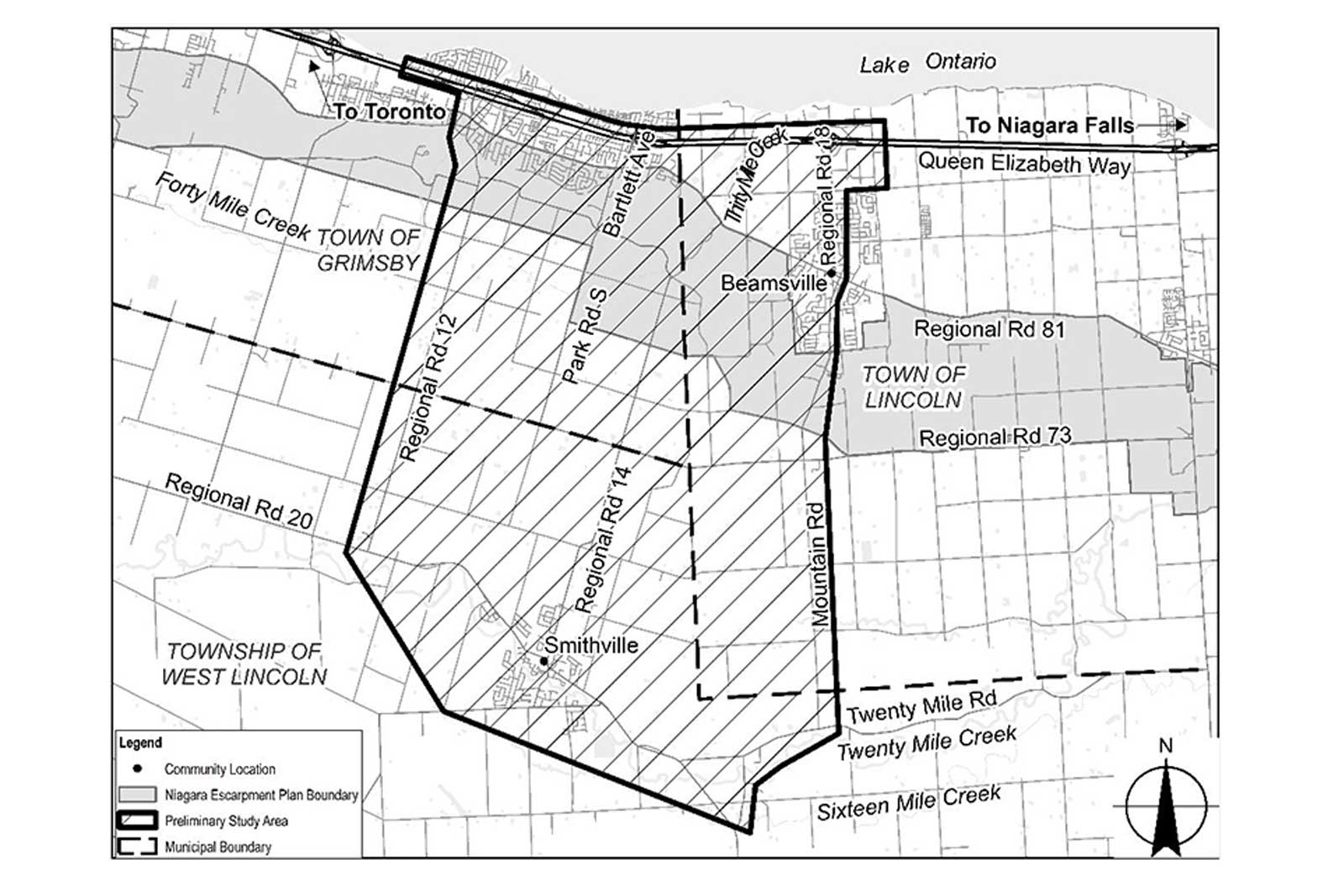
The proposed transportation crossing study area includes Grimsby, Lincoln and West Lincoln. Since the start of the project, the study area has expanded to consider all options and assess impacts.

This project will consider a new north-south link between the Queen Elizabeth Way and Highway 20 that would be more suitable for truck traffic than the existing crossings of the escarpment. A current example of this is Mountain Road (Regional Road 12) in Grimsby and Mountain Street (Regional Road 18) in Lincoln.

The existing crossings are not well suited for truck traffic. This is due to steep grades, limited room for turning and how close they are to residential neighbourhoods.

The solutions considered during the project will also consider improving road conditions for pedestrians and cyclists.

A study found an extension of Bartlett Avenue and Park Road to be the preferred corridor for the crossing. This preferred route was reported to Council in 2016. It was also part of the Region's Transportation Master Plan in 2017.

However, staff later decided a higher level of the planning process was needed. This process will show whether other options might better address safety, vehicle movement needs and environmental impacts. For this reason, the previous studies were not completed or filed with the Ministry of the Environment, Conservation and Parks.

To address these concerns, a Comprehensive Environmental Assessment has been initiated. This new initiative will independently assess and show the need for a new crossing and whether other solutions are feasible.

To achieve necessary approvals, the assessment must conduct a thorough study that considers impacts to surrounding areas when deciding the best outcome.

This study is being done under the Environmental Assessment Act as a Comprehensive Environmental Assessment (previously known as an Individual Environmental Assessment).

A Comprehensive Environmental Assessment is different than a Schedule B or C Municipal Class Environmental Assessment. It is most often used for large projects with significant environmental impacts. A Comprehensive Environmental Assessment is done when a greater level of consultation is needed.

A Comprehensive Environmental Assessment is a two-step approval process:

  • The first step is to prepare a Terms of Reference (Phase 1) that outlines how the future Environmental Assessment will be conducted. The Terms of Reference was approved by the Minister of Environment Conservation and Parks in August 2025.
  • The second step is the Environmental Assessment (Phase 2) after the Minister of Environment, Conservation and Parks approves the Terms of Reference. This is expected to start in 2026.

During a Comprehensive Environmental Assessment, interested parties can have input when the Terms of Reference is created (Phase 1) and when the full Environmental Assessment is completed (Phase 2).

Niagara Region worked with Indigenous communities, the Niagara Escarpment Commission, provincial ministries and local municipal staff while developing the Terms of Reference. The Terms of Reference has now been reviewed and approved by the Minister of the Environment, Conservation and Parks.

Consultation will continue during Phase 2 of the Environmental Assessment. More information about Phase 2 consultation activities will be shared once details are available.